The Flight That Started It All

Updated: May 7
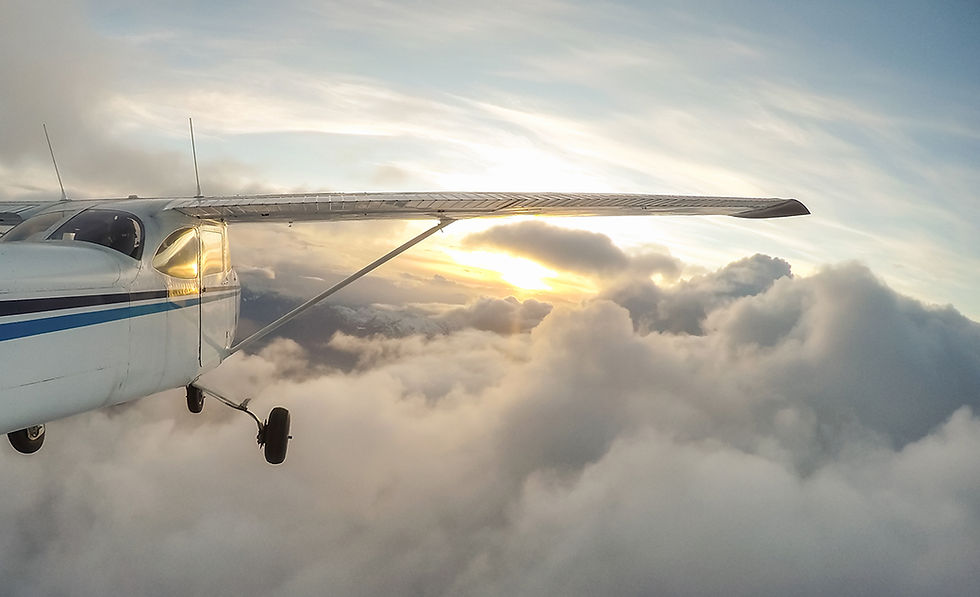
There comes a moment in most aviation careers where you make a decision that, in hindsight, feels ... optimistic.
For me, that moment came after three months of unsuccessfully trying to land a job as a test pilot in the United States.
Money was running out.
Options were thinning.
And then I saw an advertisement:
'A pilot required to ferry a Cessna 172 from San Francisco to Sydney.'
Now, for those unfamiliar with geography, that's roughly 7,000 miles (11,265 kms) across the Pacific Ocean, in a single engine aircraft better suited to weekend flying than intercontinental adventures.
Naturally, I applied.
The Aircraft
When I arrived at Oakland International Airport, I was introduced to the aircraft.
It looked like a perfectly normal Cessna 172 Skyhawk. Until I opened the door.
The cabin wasn't filled with seats. It was filled with fuel tanks.
Lots of them!
Where passengers would normally sit, there were now large auxiliary tanks holding over 120 gallons (454 litres) of fuel, effectively turning the aircraft into a flying fuel container with wings!
The plan was simple enough:
Fly from San Francisco to Honolulu
Then on to Christmas Island
Pago Pago
Norfolk Island
And finally, Sydney
Each leg was long. Some were very long.
Following the "Expert"
I wasn't alone on the journey. I was instructed to follow another pilot flying a Mooney, someone who, I assumed, knew exactly what he was doing.
That assumption would prove...slightly optimistic.
The first leg to Honolulu was around 2,100 nautical miles (3,889 kms), expected to take roughly seventeen to eighteen hours.
Long, but manageable.
Hour after hour passed. Day turned to night. Fuel levels slowly dropped. And yet... there was no sign of Honolulu. No lights. No coastline. No reassuring indication that we were anywhere near where we were supposed to be.
At this point, you start to reconsider your life choices.
A Slight Navigation Issue
Eventually, I turned to the one piece of equipment that might save the day, the radio compass. After some searching, I picked up a signal from Honolulu.
It was off my left wing.
Which was mildly concerning, given I had been flying straight for quite some time.
I turned toward it.
At this stage, fuel was becoming a rather serious consideration.
I began lightening the aircraft. Out went anything that wasn't essential.
Water. Food. Bits and pieces. (The life raft, however, stayed firmly on board. Some decisions are still rational under pressure.)
Eventually, with fuel running low, I declared an emergency and made for the nearest available airfield, a marine base at Kaneohe, on the northern side of Oahu.
When I landed, I had been airborne for around eighteen hours.
And, as it turned out, about 300 miles off track.
A small detail.
Island to Island
After a well earned rest, the journey continued.
Next stop: Christmas Island, a tiny speck in the Pacific, notable for its isolation and a rather unusual history involving nuclear testing.
Navigation for this leg relied on a non directional beacon that could be picked up from a few hundred miles away.
Assuming, of course, it was switched on.
There were no alternate airfields. No second chances.
Fortunately, on this occasion, the beacon was working, the island appeared exactly where it was supposed to be, and the landing was uneventful, which, by this stage of the trip, felt like a luxury.
From there, it was onward to Pago Pago, then Norfolk Island, and finally the last stretch to Sydney.
The Long Way Home
Six days. Nearly 7,000 miles. Around 60 hours of flying time.
All completed in a single engine aircraft packed with fuel tanks and a healthy dose of determination.
When I finally arrived in Sydney, I was ready for two things:
A proper rest.
And getting paid.
The Beginning of Something Bigger - The Flight That Started It All
Looking back, that flight was more than just a job.
It was the beginning of something much larger.
Somewhere along the way, perhaps while navigating toward Honolulu with diminishing fuel, I realised that ferry flying could be done better, safer, and more professionally.
That idea eventually led to the creation of a business that would go on to ferry aircraft all over the world.
But like many things in aviation...
The flight that started it all, began with a slightly ambitious decision and a willingness to say:
"Yes, I'll take the job."
Want the full story?
This is just one of many real aviation stories from a career spent flying aircraft across oceans, into remote regions, and occasionally into situations that weren't quite as straightforward as they first appeared..
If you enjoy aviation stories that combine adventure, humour, and the reality of flying in unpredictable conditions, you'll find plenty more in Life on a Wing and a Prayer.


